8 Best Bolt Alternatives in 2026, Compared
Eight Bolt.new alternatives compared on price, free plan, code export, backend and mobile, with prices checked on 21 November 2026 and a plain note on when each one fits.
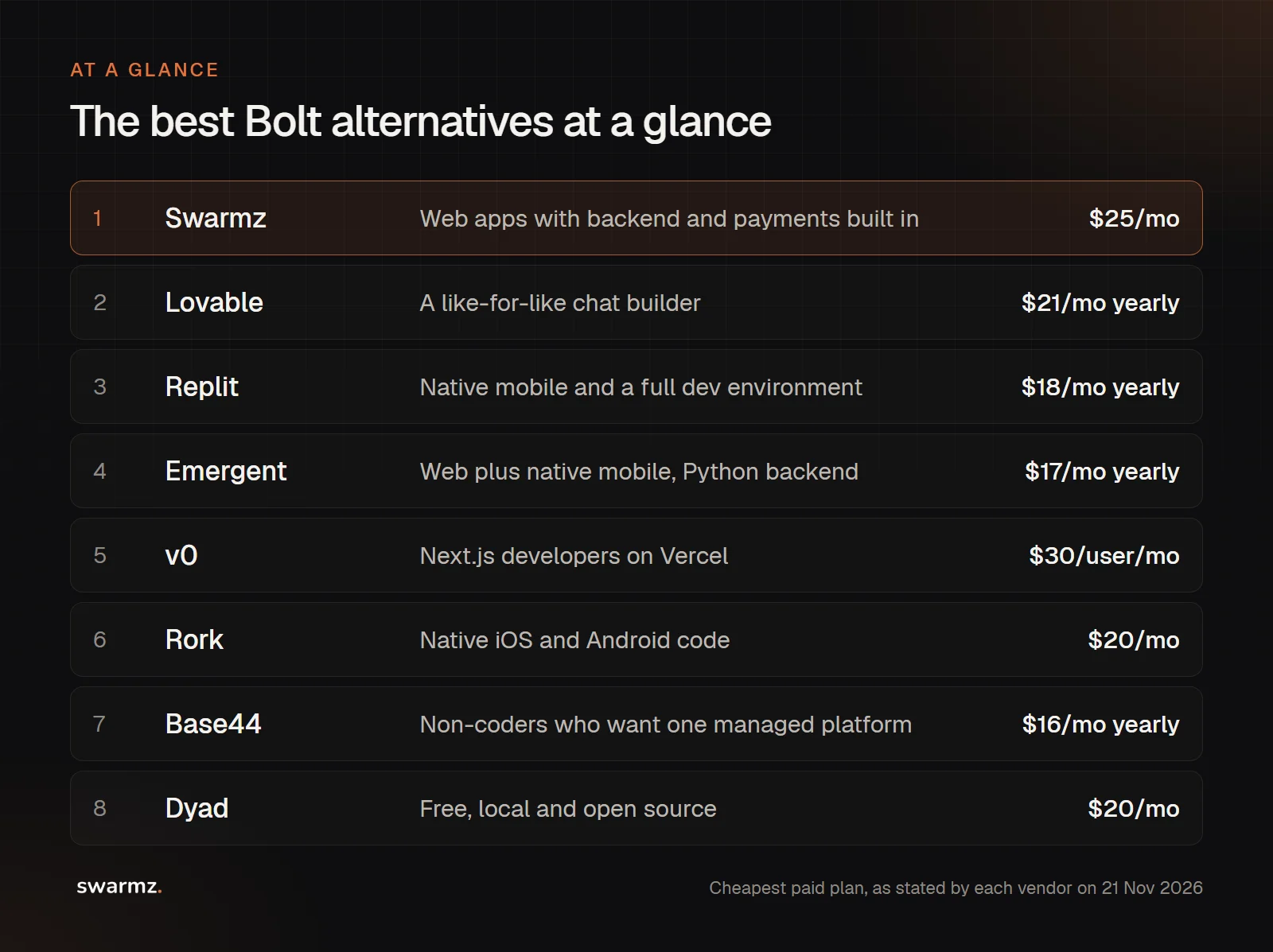
The best Bolt alternative for most people is Swarmz, because it does what you used Bolt for, turning a plain-language prompt into a working web app, with the backend already in place: a database, user sign-in, file storage, Stripe payments and two-way GitHub sync, at the same $25 Pro price and with a free plan of 5 credits a day. If you used Bolt for Expo mobile apps or want to edit code in a full environment, Rork, Replit or Emergent may suit you better, and the table below shows why.
Swarmz is our product, so weigh our ranking with that in mind. Every price in this article was checked on the vendor's own pricing page or docs on 21 November 2026, and the sources are listed at the end.
Bolt alternatives at a glance
Tool | Best for | Starting paid price | Free plan | Code export | Backend and payments |
|---|---|---|---|---|---|
Swarmz | Most people leaving Bolt | $25/month (Pro) | 5 credits a day, no card | Two-way GitHub sync, on Free too | Built-in database, sign-in, storage; Stripe payments |
Lovable | A like-for-like chat builder | $25/month (Pro), $21 billed yearly | 5 daily credits, up to 30 a month | Git sync; ZIP on paid plans | Lovable Cloud or your own Supabase; Stripe |
Replit | Native mobile and a full dev environment | $20/month (Core), $18 billed yearly | Yes, 1 published app that goes down after 30 days | GitHub or GitLab | Built-in PostgreSQL; Stripe connector on paid plans |
Emergent | Web plus native mobile with a Python backend | $20/month (Standard), $17 billed yearly | 10 credits, no production publishing | GitHub push on paid plans | Built-in MongoDB; Stripe listed |
v0 | Next.js developers on Vercel | $30 per user/month (Plus) | 7 messages a day | Two-way GitHub sync | Connects to your own backend; database and payments not stated |
Rork | Native iOS and Android code | $20/month (Rork Max) | Design mode only | Two-way GitHub sync on paid plans | Serverless functions plus Supabase or Firebase; RevenueCat |
Base44 | Non-coders who want one managed platform | $16/month (Starter), billed yearly | 25 message credits, up to 5 apps | GitHub and ZIP from the Builder plan | Built-in backend; Stripe, Wix Payments, PayPal |
Dyad | A free, local, open-source builder | Free app; Pro $20/month | Yes, with your own AI API key | Plain Next.js code | Connect Supabase or Neon; payments not stated |
Bolt (for reference) | JavaScript web apps and Expo prototypes | $25/month (Pro) | 1M tokens a month, 300K daily cap | GitHub integration | Bolt Database or Supabase; Stripe announced as private beta |
Why people look for a Bolt alternative
Bolt gets a prototype on screen in the browser, and if it works for you there is no reason to move. People usually look elsewhere for one of four reasons:
They want a backend that is ready on day one. Bolt Cloud gives every project a managed database, but sign-in, file storage and Stripe were announced as a private beta, and Bolt supports JavaScript backends only.
They want native mobile code. Bolt builds mobile apps with Expo; some teams want SwiftUI and Kotlin instead.
They want to stop thinking in tokens. Bolt's free plan gives 1M tokens a month with a 300K daily cap and Bolt branding on sites. Pro starts at 10M tokens a month, with unused tokens rolling over for up to two months, and on Teams each member gets an allowance that is not shared with the rest of the team.
They want a different workflow, such as a full code environment, a local app with their own AI key, or Vercel pull requests.
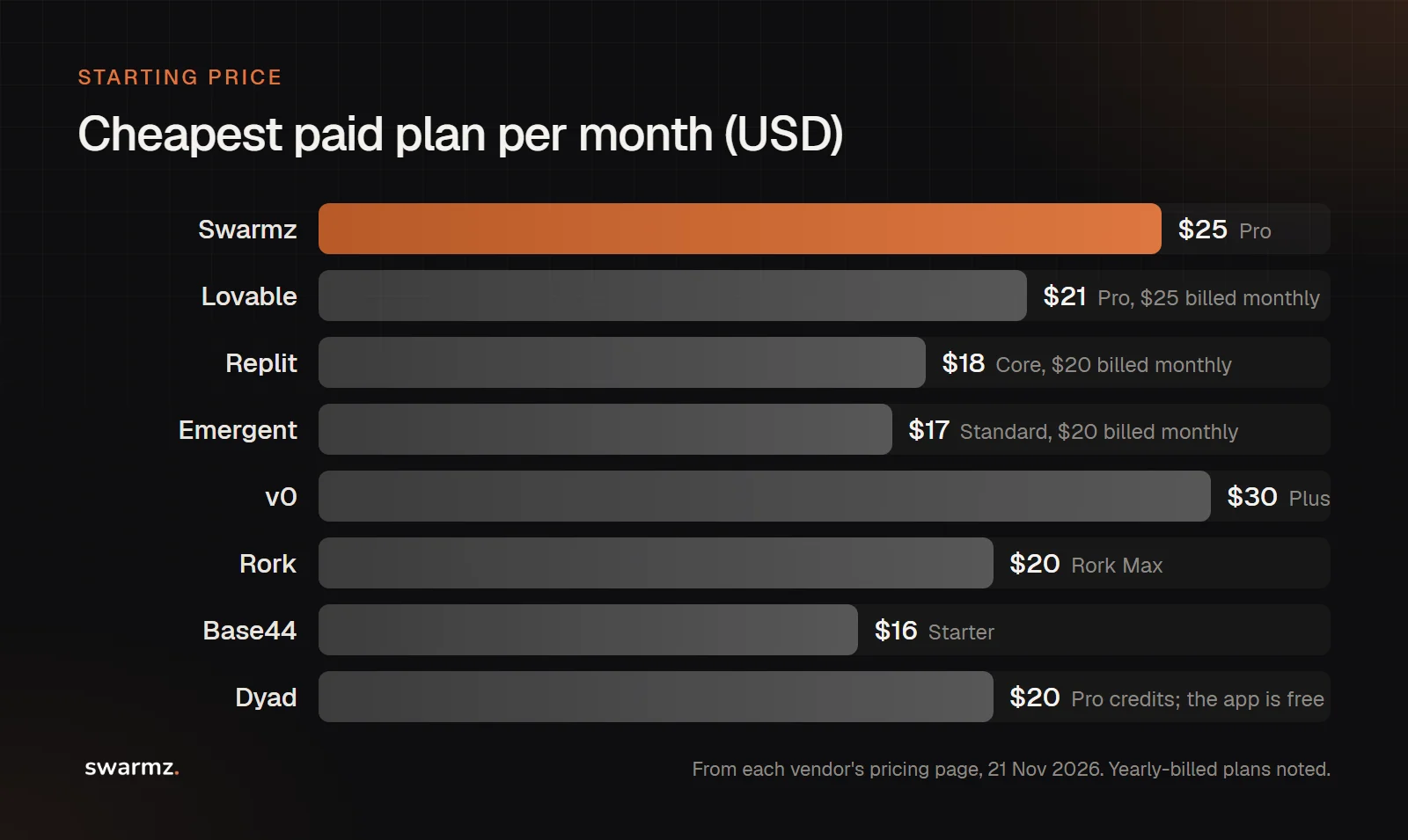
On price, most alternatives sit close to Bolt: Swarmz, Lovable and Bolt Pro start at $25 a month, Replit, Emergent and Rork at $20, Base44 at $16 billed yearly, and v0 at $30 per user. Each meters usage differently, in credits, tokens or messages, so compare what a month of your own building would cost.
For a closer look at the four tools people compare most, see our Bolt vs Lovable vs Replit vs v0 comparison.
1. Swarmz: best Bolt alternative overall
Swarmz is an AI app builder for web apps. You describe what you want in chat, and Swarmz builds the screens, the database and the sign-in, then publishes the app to a swarmz.cloud link with SSL in one click. The code is standard React, TypeScript and Tailwind, and it syncs both ways with your own GitHub repository, on the free plan too.
The main difference from Bolt is what is already switched on. Swarmz Cloud gives every app a database, user sign-in, file storage and server functions on every plan, including Free. Sign-in covers email, phone, Google, Apple, GitHub, Microsoft and more. Swarmz Payments runs on Stripe for checkout, subscriptions, invoices and payment links. You can start from one of 28 templates and connect more than 80 services, such as Shopify, Notion and HubSpot, in one click each. Credits are shared by the whole workspace with no per-seat fees, where Bolt Teams is $30 per member. Our Swarmz vs Bolt comparison goes through each difference.
Pros
Database, sign-in, file storage and server functions on every plan, including Free, plus built-in Stripe payments (Stripe's fees and a small Swarmz platform fee apply).
Two-way GitHub sync on the free plan, with standard React and TypeScript code.
Shared credits, no per-seat fees, and Admin, Editor and Viewer roles on Free.
Your account and main database are hosted in the EU (Ireland).
Cons
Web apps only. Swarmz does not build native iOS or Android apps, so there is no equivalent to Bolt's Expo route.
There is no ZIP download; you get your code through GitHub.
Custom domains need the Pro plan.
Best for: founders, small businesses and agencies who want a complete web app with a backend and payments, without wiring services together.
Pricing: Free with 5 credits every day and no card. Pro is $25 a month for 100 credits plus the daily credits, with unused credits rolling over for 30 days, top-ups and a custom domain. Business is $50 a month and adds private apps, SAML single sign-on and custom design systems. New accounts can also try Pro free for 3 days with 25 credits; the trial needs a card and becomes the $25 Pro plan unless you cancel.
2. Lovable: best like-for-like chat builder
Lovable builds web apps from chat, much like Bolt, with Lovable Cloud for the database, sign-in, storage and functions, or your own Supabase project. Git sync to GitHub, GitLab or Bitbucket works on every plan, and paid plans can download the code as a ZIP. Our list of Lovable alternatives covers the same field from the other side.
Pros: Git sync on every plan, including Free; a built-in backend; unlimited workspace members, with pricing based on credits rather than seats.
Cons: no native mobile apps, so you lose Bolt's Expo route; credit use varies by task, and Cloud and AI usage draw credits too; no custom domain or code download on Free.
Best for: Bolt users who want the same kind of chat builder at the same price, with a backend included.
Pricing: Pro is $25 a month, or $250 a year ($21 a month) billed yearly. Business is $50 a month.
3. Replit: best for native mobile and a full dev environment
Replit is an online development environment with an AI Agent that builds web apps and native iOS and Android apps, then publishes them. It includes a managed PostgreSQL database with no keys to set up, Replit Auth or Clerk for sign-in, and a Stripe connector on paid plans. If you liked editing Bolt's code, Replit gives you a full environment around it. Our Replit alternatives guide covers where it falls short.
Pros: native mobile apps from the same agent; built-in Postgres; a real code environment, with up to 5 collaborators on Core.
Cons: usage-based billing, where credits cover AI, publishing, network transfer and database storage, so costs move with use; the free plan's published app goes down after 30 days.
Best for: builders who want native mobile apps or a development environment around the AI.
Pricing: Core is $20 a month, or $18 a month billed yearly, per Replit's pricing page. Pro is $100 a month, or $90 billed yearly.
4. Emergent: best for web plus native mobile with a Python backend
Emergent builds full-stack web apps and React Native mobile apps with Expo, and can submit builds to the App Store and Google Play through EAS. Backends use Python (FastAPI) or Next.js API routes, with a MongoDB Atlas database for each project. For Bolt users held back by JavaScript-only backends, Python is the main draw.
Pros: native mobile with store submission; a backend and database set up for you; GitHub push and a custom domain on the $20 plan.
Cons: no download button, so export goes through GitHub on paid plans; MongoDB only, with no row-level security and no external database clients; free users cannot publish to production, and publishing takes about 10 to 15 minutes.
Best for: builders who want a web app and a mobile app from one project, or a Python backend.
Pricing: Standard is $20 a month, or $17 a month billed yearly. Pro is $200 a month.
5. v0: best for Next.js developers on Vercel
v0, now at v0.app, is Vercel's AI agent for code and full-stack apps. Its strength is the developer workflow: two-way GitHub sync, branches, pull requests and a Vercel preview for every branch.
Pros: a clean GitHub and pull request flow; one-click deploys on Vercel; a free tier that includes GitHub sync.
Cons: the free plan allows 7 messages a day; the $20 Premium plan is being retired, so new users start at $30 per user a month; the pages we read do not describe a built-in database, payments or mobile apps.
Best for: developers already on Vercel.
Pricing: Plus is $30 per user a month; Business is $100 per user a month.
6. Rork: best for native iOS and Android code
If you used Bolt's Expo route and want native code instead, Rork generates iOS apps in SwiftUI, Android apps in Kotlin and Jetpack Compose, and web apps in React. It compiles in the cloud and submits iOS builds to App Store Connect; for Android it produces an .aab file that you upload to Google Play Console yourself. In-app purchases and subscriptions run through a built-in RevenueCat integration.
Pros: real native code; two-way GitHub sync and Xcode or Kotlin project exports on paid plans; a direct App Store submission flow.
Cons: the free plan is design mode only and cannot build or publish; a database means adding Supabase or Firebase; you need an Apple Developer membership to publish on the App Store.
Best for: founders whose product has to be a real App Store and Google Play app.
Pricing: Rork Max starts at $20 a month for 100 credits, billed monthly.
7. Base44: best managed platform for non-coders
Base44, owned by Wix since 2025 and run as its own product, builds full-stack apps, websites and AI agents with a managed backend, sign-in and hosting, plus Stripe, Wix Payments or PayPal for payments.
Pros: backend, database and sign-in on every plan, including Free; a custom domain from the cheapest paid plan; three documented payment options.
Cons: GitHub sync and code export need the Builder plan ($40 a month billed yearly) or higher; the mobile app is a web view wrapper without native features; prices are shown for yearly billing only.
Best for: non-coders who want one managed platform and do not need the code early.
Pricing: Starter is $16 a month billed yearly; Builder is $40 a month billed yearly.
8. Dyad: best free, local and open-source option
Dyad is an open-source AI app builder that runs on your own computer with your own AI API key or a local model. It writes standard Next.js code, and you connect Supabase or Neon for a database and sign-in.
Pros: free and open source; your code and data stay on your machine; no lock-in, because the output is plain Next.js.
Cons: a desktop install; no built-in hosting, domains or payments; mobile means wrapping the web app with Capacitor.
Best for: developers who want Bolt-style prompting on their own machine, with their own model keys.
Pricing: the app is free with your own key. Pro is $20 a month for 200 AI credits.
When Swarmz isn't the right pick
Swarmz builds web apps that work on phones, not native apps. If your app has to be in the App Store or Google Play, choose Rork for native SwiftUI and Kotlin code, Replit or Emergent for mobile with a backend, or stay on Bolt's Expo route. Our guide on whether AI can build a mobile app explains the trade-offs. If you want to edit code in a full environment as you build, Replit fits better. If everything must stay on your own machine, use Dyad. If you need a ZIP rather than a GitHub repository, Lovable's paid plans and Dyad give you one. If your team works through Vercel pull requests, use v0.
Tool | Free plan | Code export | Backend | Payments | Native mobile |
|---|---|---|---|---|---|
Swarmz | Yes | Yes | Yes | Yes | No |
Lovable | Yes | Yes | Yes | Yes | No |
Replit | Yes | Yes | Yes | Yes | Yes |
Emergent | Yes | Partly | Yes | Yes | Yes |
v0 | Yes | Yes | Partly | No | No |
Rork | Partly | Partly | Partly | Yes | Yes |
Base44 | Yes | Partly | Yes | Yes | Partly |
Dyad | Yes | Yes | Partly | No | Partly |
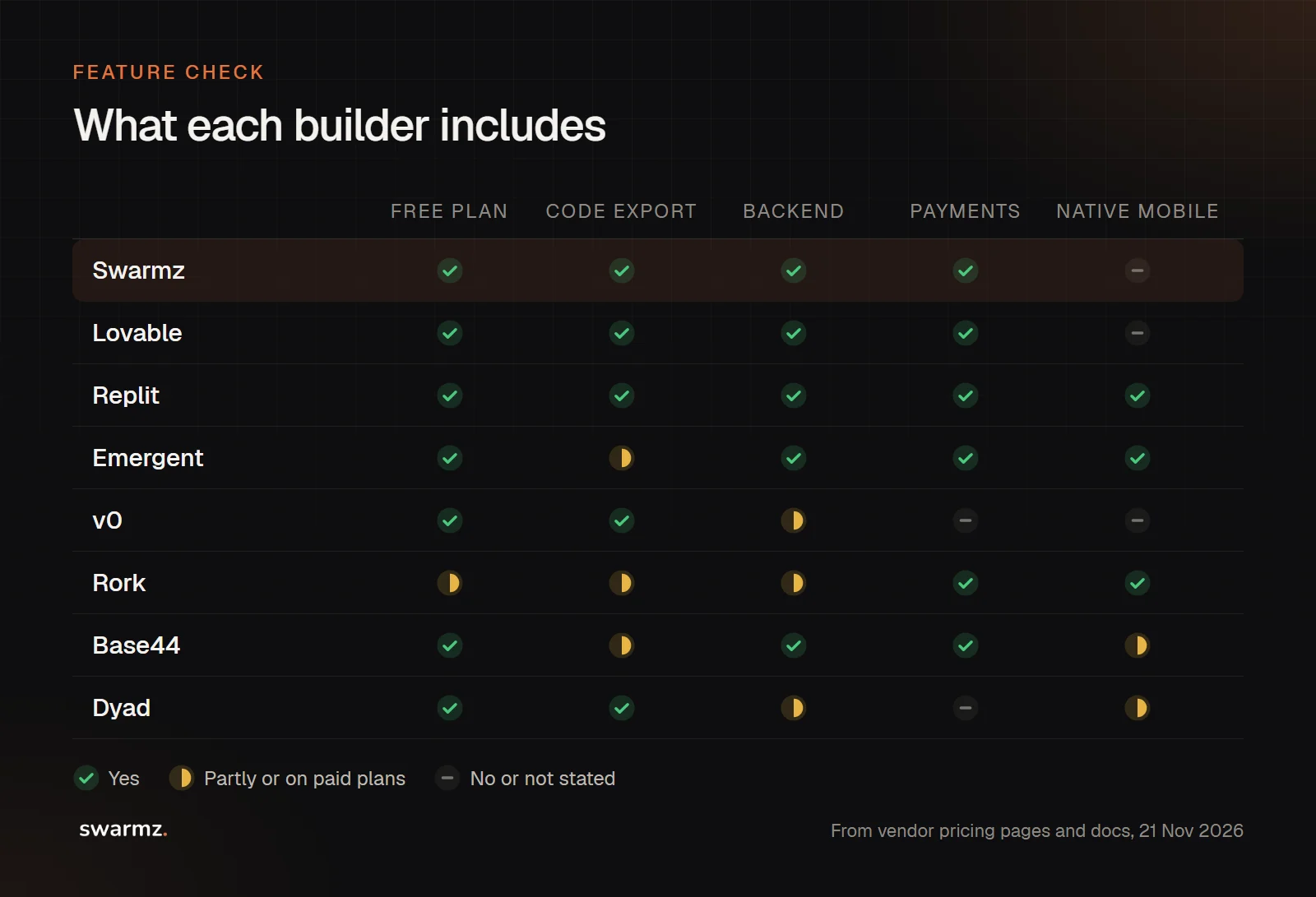
Yes: included. Partly: only on some plans or with limits. No: not offered, or not stated by the vendor. Checked on 21 November 2026.
How to choose
You want what Bolt gives you, with the backend and payments ready: Swarmz.
You want the same kind of chat builder at the same price: Lovable.
You need native mobile apps: Rork for native code, or Replit or Emergent for mobile with a backend.
You need a Python backend: Emergent.
You live in Vercel and GitHub pull requests: v0.
You want one managed platform and do not need the code yet: Base44.
You want free, local and open source: Dyad.
Before you move, check how you would leave the next tool too: see how to export an app from an AI app builder.
FAQ
What is the best alternative to Bolt.new?
For most people, Swarmz. It builds web apps from a prompt like Bolt does, with a database, sign-in, Stripe payments and two-way GitHub sync included, Pro at the same $25 a month and a free plan of 5 credits a day. For native mobile apps, Rork, Replit or Emergent fit better.
Is there a free Bolt alternative?
Yes. Dyad is free and open source when you use your own AI API key. Swarmz has a free plan with 5 credits every day and no card, and Lovable's free plan gives 5 daily credits, up to 30 a month.
Is Lovable better than Bolt?
Neither is better for everything. Both start at $25 a month for Pro. Lovable includes Git sync on every plan, a built-in backend and a ZIP download on paid plans, while Bolt builds Expo mobile apps, which Lovable does not. Lovable meters use in credits and Bolt in tokens.
Which Bolt alternative builds native mobile apps?
Rork builds native SwiftUI and Kotlin apps, and Replit and Emergent build native iOS and Android apps. Swarmz and Lovable build web apps that work on phones but are not native apps.
Can I move my Bolt project to another app builder?
Your code, yes: Bolt's GitHub integration backs up your project to a GitHub repository. Whether the new builder can pick up an existing repository varies (Lovable creates a new one rather than connecting yours), so check first, and plan to move your data separately.
Ready to try the top pick?
If you want what you used Bolt for, with the database, sign-in and payments already built in, start building on Swarmz for free. Describe the app in a sentence, and you can publish the first version the same day.
Sources
All checked on 21 November 2026.
Swarmz: swarmz.net/pricing, swarmz.net/faq, swarmz.net/features
Bolt: bolt.new/pricing, Bolt supported technologies, Bolt GitHub integration, Bolt Cloud announcement
Lovable: docs.lovable.dev subscription plans, docs.lovable.dev FAQ, lovable.dev/pricing
Replit: replit.com/pricing, Replit Core docs, Replit Starter plan docs, Replit mobile apps docs
Emergent: emergent.sh/pricing, Emergent FAQ, Emergent plans and credits
Base44: base44.com/pricing, Base44 payments docs, Base44 mobile docs
Dyad: dyad.sh, Dyad mobile app guide
How did this land?
About the author

Founder of swarmz.net
Jordan founded Swarmz, the AI app builder at swarmz.net.


