8 Best Lovable Alternatives in 2026, Compared
Eight Lovable alternatives compared on price, free plan, code export, backend and mobile, with prices checked on 21 November 2026 and an honest note on when each one fits.
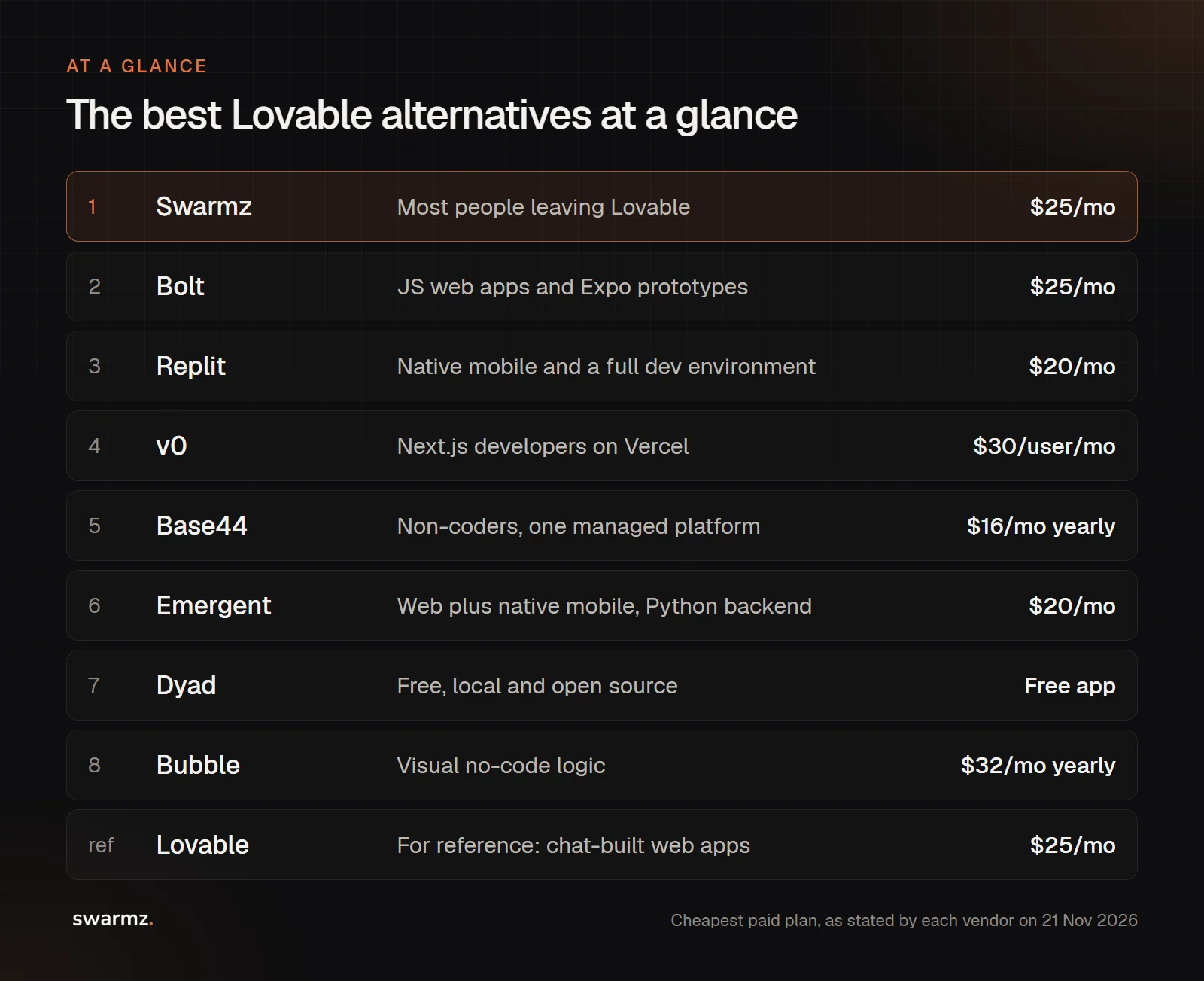
The best Lovable alternative for most people is Swarmz. It works the way Lovable does, you describe an app in plain words and get a working web app, and it includes a database, sign-in, file storage, Stripe payments and GitHub sync, with a free plan of 5 credits a day and Pro at $25 a month. If you need something Swarmz does not do, such as native iPhone apps or a fully local, open-source setup, Replit, Emergent or Dyad are better picks, and the table below shows why.
Swarmz is our product, so weigh our ranking with that in mind. Every price in this article was checked on the vendor's own pricing page or docs on 21 November 2026, and the sources are listed at the end.
Lovable alternatives at a glance
Tool | Best for | Starting paid price | Free plan | Code export | Backend and payments |
|---|---|---|---|---|---|
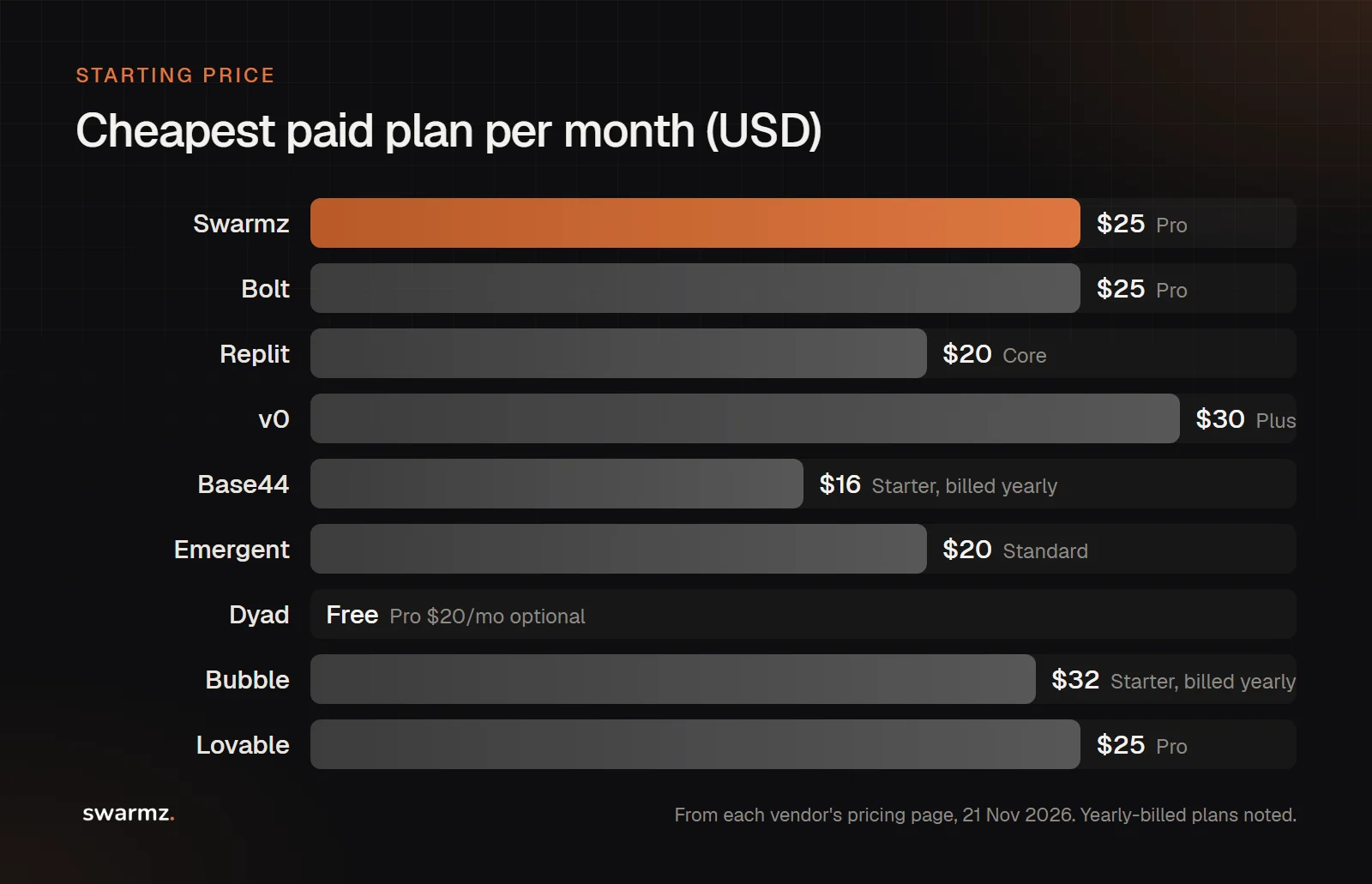
Swarmz | Most people leaving Lovable | $25/month (Pro) | 5 credits a day, no card | Two-way GitHub sync | Built-in database, sign-in, storage; Stripe payments |
Bolt | JavaScript web apps and Expo mobile prototypes | $25/month (Pro) | 1M tokens a month, 300K daily cap | GitHub integration | Bolt Database or Supabase; Stripe announced as private beta |
Replit | Native mobile apps and a full dev environment | $20/month (Core), $18 billed yearly | Yes, 1 published app that goes down after 30 days | GitHub or GitLab | Built-in PostgreSQL; Stripe connector on paid plans |
v0 | Next.js developers on Vercel | $30 per user/month (Plus) | 7 messages a day | Two-way GitHub sync | Backend details not stated; deploys to Vercel |
Base44 | Non-coders who want one managed platform | $16/month (Starter), billed yearly | 25 message credits, up to 5 apps | GitHub and ZIP from the Builder plan | Built-in backend; Stripe, Wix Payments, PayPal |
Emergent | Web plus native mobile with a Python backend | $20/month (Standard), $17 billed yearly | 10 credits, no production publishing | GitHub push on paid plans | Built-in MongoDB; Stripe listed |
Dyad | A free, local, open-source builder | Free app; Pro $20/month for credits | Yes, with your own AI API key | Plain Next.js code | Connect Supabase or Neon; payments not stated |
Bubble | Visual no-code logic | $32/month (Starter), billed yearly | 500 AI credits, 50K workload units | No code export | Built-in database and workflows |
Lovable (for reference) | Chat-built web apps | $25/month (Pro) | 5 daily credits, up to 30 a month | Git sync; ZIP download on paid plans | Lovable Cloud or your own Supabase; Stripe |
Why people look for a Lovable alternative
Lovable is a capable tool, and if it works for you there is no reason to move. People usually start looking for one of four reasons: they want native mobile apps, which Lovable does not build; they want more control over cost; they want to keep code and data on their own machine; or they need visual logic they can edit without prompting. Each alternative below is strongest at one of these. For a deeper look at the tools people compare most, see our Bolt vs Lovable vs Replit vs v0 comparison.
1. Swarmz: best Lovable alternative overall
Swarmz is an AI app builder for web apps. You describe what you want in chat, and Swarmz builds the screens, the database and the sign-in, then publishes the app to a swarmz.cloud link with SSL in one click. The generated code is standard React, TypeScript and Tailwind, and it syncs both ways with your own GitHub repository, on the free plan too.
What makes it a strong Lovable replacement is that the parts you would otherwise wire up yourself are already there. Swarmz Cloud gives every app a database, user sign-in, file storage and server functions, and Swarmz Payments runs on Stripe for checkout, subscriptions, invoices and payment links. More than 80 connectors, including Stripe, Shopify, Notion, Airtable, Google Sheets, HubSpot and Calendly, connect in one click. Each reply in the chat shows how many credits that prompt used, so you can see what a change cost before you make the next one.
Pros
Backend, sign-in and storage are built in on every plan, including Free, and Swarmz Payments adds Stripe checkout, subscriptions and invoices (Stripe's fees plus a small Swarmz platform fee apply).
Two-way GitHub sync on the free plan, with standard React and TypeScript code.
Credits are shared by the whole workspace with no per-seat fees, and teammates get Admin, Editor or Viewer roles.
Your account and main database are hosted in the EU (Ireland), which helps if your customers are in Europe.
Cons
Web apps only. Swarmz does not build native iOS or Android apps today.
There is no ZIP download; you get your code through GitHub.
Custom domains need the Pro plan.
Best for: founders, small businesses and agencies who want a full web app with a backend and payments, without stitching services together.
Pricing: Free with 5 credits every day and no card. Pro is $25 a month for 100 credits plus the daily credits, with unused credits rolling over for 30 days and custom domains included. Business is $50 a month and adds private apps, SAML single sign-on and custom design systems.
2. Bolt: best for JavaScript web apps and Expo mobile prototypes
Bolt is a browser-based builder for websites, web apps and mobile apps. Mobile apps are built with Expo when you mention "mobile app" in your first prompt. Projects get a managed Bolt Database through Bolt Cloud, or you can connect Supabase, and the GitHub integration commits your work and picks up outside changes.
Pros: a free plan with hosting; an Expo route to mobile; two-way GitHub integration with branches.
Cons: the free plan has a 300K daily token cap and Bolt branding on sites; backends are JavaScript only; some Bolt Cloud features, including Stripe, were announced as a private beta.
Best for: developers and tinkerers who want fast JavaScript prototypes, including a mobile version.
Pricing: Free with 1M tokens a month. Pro is $25 a month billed monthly; Teams is $30 per member a month.
3. Replit: best for native mobile apps and a full dev environment
Replit is an online development environment with an AI Agent that builds web apps and native iOS and Android apps, then publishes them. It includes a managed PostgreSQL database with no keys to set up, Replit Auth or Clerk for sign-in, and a Stripe connector on paid plans.
Pros: native mobile apps from the same agent; built-in Postgres; a full code environment when you want to edit by hand.
Cons: usage-based billing covers AI, publishing, data transfer and storage, so costs move with use; the free plan's published app goes down after 30 days; Replit's own docs do not state the Core price, only the pricing page does.
Best for: builders who want native mobile apps or a real development environment around the AI.
Pricing: Core is $20 a month, or $18 a month billed yearly, per Replit's pricing page. Pro is $100 a month.
4. v0: best for Next.js developers on Vercel
v0, now at v0.app, is Vercel's AI agent for building code and full-stack apps. Its strength is the developer workflow: two-way GitHub sync, working branches, pull requests and a Vercel preview for every branch.
Pros: a clean GitHub and pull request flow; one-click deploy on Vercel; a free tier that includes GitHub sync.
Cons: the free plan allows 7 messages a day; the $20 Premium plan is being retired, so new users start at $30 per user a month; the pages we read do not state built-in database, payments or custom domain support.
Best for: developers already on Vercel who want generated code to land in a normal Git workflow.
Pricing: Plus is $30 per user a month for new users; Business is $100 per user a month.
5. Base44: best all-in-one option for non-coders
Base44, owned by Wix since 2025 and still run as its own product, builds full-stack apps, websites and AI agents with a managed backend, sign-in and hosting. Payments work through Stripe, Wix Payments or PayPal.
Pros: backend, database and sign-in on every plan, including Free; a custom domain from the cheapest paid plan; three documented payment options.
Cons: GitHub sync and code export need the Builder plan ($40 a month billed yearly) or higher; the mobile app is a web view wrapper, so native features are not supported; prices are shown for yearly billing only.
Best for: non-technical builders who want one managed platform and do not need the code early.
Pricing: Starter is $16 a month billed yearly; Builder is $40 a month billed yearly.
6. Emergent: best for web and native mobile with a Python backend
Emergent builds full-stack web apps and React Native mobile apps with Expo, and can submit builds to the App Store and Google Play. Backends use Python (FastAPI) or Next.js API routes with a MongoDB Atlas database per project.
Pros: native mobile via Expo; a backend and database provisioned for you; the $20 plan includes GitHub push and a custom domain.
Cons: no download button, so export is through GitHub on paid plans; MongoDB only, with no row-level security and no external database clients; free users cannot publish to production.
Best for: builders who want a mobile app and a web app from one project.
Pricing: Standard is $20 a month, or $17 billed yearly. Pro is $200 a month.
7. Dyad: best free, local and open-source option
Dyad is an open-source AI app builder that runs on your own computer. You bring your own AI API key, or use a local model, and it writes standard Next.js code that you can open in any editor. For a database and sign-in, you connect Supabase or Neon.
Pros: free and open source; your code and data stay on your machine; no lock-in, because the output is plain Next.js.
Cons: you install a desktop app; there is no built-in hosting, domains or payments, so you assemble Supabase or Neon and a host yourself; mobile means wrapping the web app with Capacitor.
Best for: developers who want privacy and full control and are happy to manage their own stack.
Pricing: the app is free with your own key. Pro is $20 a month for 200 AI credits.
8. Bubble: best for visual no-code logic
Bubble is a visual no-code platform for web and mobile apps with a built-in database, workflows and an AI agent. Instead of reading code, you edit logic visually, and mobile apps are built with React Native from the same backend.
Pros: database, workflows and APIs in one tool; mobile apps from the same backend; Bubble says its source code will be released under an open-source licence if the company shuts down.
Cons: no code export, so leaving means rebuilding; usage is metered in workload units with overage charges; the cheapest paid plan is billed yearly.
Best for: teams who want to own and edit complex logic visually and are comfortable staying on Bubble.
Pricing: Starter is $32 a month billed yearly; Growth is $119 a month billed yearly.
When Swarmz isn't the right pick
Swarmz builds web apps. If your app has to be in the App Store or Google Play as a native app, choose Replit, Emergent or Bolt with Expo, or read our guide on whether AI can build a mobile app first. If you must run everything on your own machine with your own model keys, Dyad fits better. If you want to edit every rule visually rather than through chat, Bubble is built for that. And if you need a ZIP of your code rather than a GitHub repository, Lovable's paid plans and Dyad give you one.
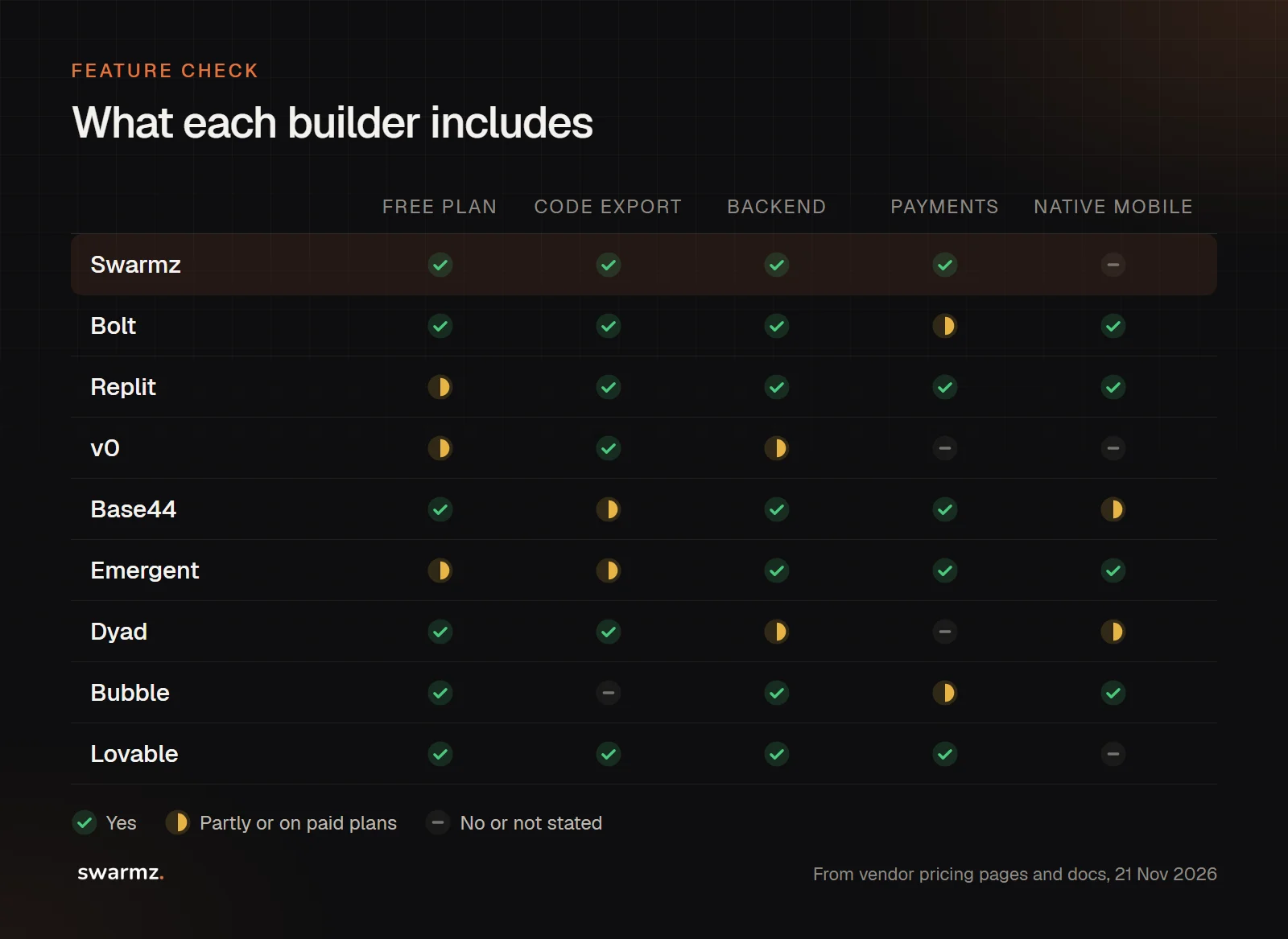
Tool | Free plan | Code export | Backend | Payments | Native mobile |
|---|---|---|---|---|---|
Swarmz | Yes | Yes | Yes | Yes | No |
Bolt | Yes | Yes | Yes | Partly | Yes |
Replit | Partly | Yes | Yes | Yes | Yes |
v0 | Partly | Yes | Partly | No | No |
Base44 | Yes | Partly | Yes | Yes | Partly |
Emergent | Partly | Partly | Yes | Yes | Yes |
Dyad | Yes | Yes | Partly | No | Partly |
Bubble | Yes | No | Yes | Partly | Yes |
Lovable (reference) | Yes | Yes | Yes | Yes | No |
Yes: included. Partly: only on some plans or with limits. No: not offered, or not stated by the vendor. Checked on 21 November 2026.
How to choose
You want the closest replacement for Lovable with more built in: Swarmz.
You need native mobile apps: Replit or Emergent, or Bolt for an Expo prototype.
You live in Vercel and GitHub pull requests: v0.
You want one managed platform and do not need the code yet: Base44.
You want free, local and open source: Dyad.
You want visual logic you can edit by hand: Bubble.
Whichever you pick, check how you would leave before you commit. Our guide on how to export an app from an AI app builder covers what usually comes with you and what does not, and the honest limitations of AI app builders is worth reading before you plan a launch.
FAQ
What is the best alternative to Lovable?
For most people, Swarmz. It builds web apps from chat like Lovable does, and includes a database, sign-in, storage, Stripe payments and GitHub sync on the same $25 Pro price, with a free plan of 5 credits a day. If you need native mobile apps, Replit or Emergent fit better.
Is there a free Lovable alternative?
Yes. Dyad is free and open source when you use your own AI API key. Swarmz has a free plan with 5 credits every day and no card, and Bolt's free plan includes 1M tokens a month.
Which Lovable alternative builds native mobile apps?
Replit and Emergent build native iOS and Android apps, and Bolt builds mobile apps with Expo. Lovable and Swarmz build web apps that work on phones but are not native apps.
Can I move a Lovable project to another app builder?
Lovable can sync your code to GitHub on any plan, and paid plans can download it as a ZIP. Whether another builder can pick up an existing repository varies, so check that before you move, and plan to export your database separately.
Is Lovable cheaper than Bolt?
Their entry prices match: Lovable Pro and Bolt Pro both start at $25 a month billed monthly. They meter usage differently, Lovable in credits and Bolt in tokens, so the real cost depends on how much you build.
Ready to try the top pick?
If you want a web app with a backend and payments already built in, start building on Swarmz for free. Describe the app in a sentence, and you can publish the first version the same day.
Sources
All checked on 21 November 2026.
Swarmz: swarmz.net/pricing, swarmz.net/faq
Lovable: docs.lovable.dev subscription plans, docs.lovable.dev FAQ
Base44: base44.com/pricing, Base44 payments docs
Emergent: emergent.sh/pricing, Emergent FAQ
Dyad: dyad.sh
Bubble: bubble.io/pricing, Bubble data ownership
How did this land?
About the author

Founder of swarmz.net
Jordan founded Swarmz, the AI app builder at swarmz.net.


