Best AI App Builder for Startups and MVPs (2026)
Seven AI app builders compared on what a founder needs from an MVP: a real backend and sign-in, subscriptions, code in GitHub for your first engineers, team roles, cost control and a path to native mobile. Prices checked on 21 November 2026.
The best AI app builder for most startups is Swarmz, because it gives an MVP the parts it needs before anyone can pay for it: a real database, user sign-in including Google, Microsoft and SAML SSO, Stripe subscriptions, and standard React and TypeScript code that syncs both ways with your own GitHub repository, so your first engineers inherit a normal codebase. The whole team works in one workspace with roles and no per-seat fees. Swarmz builds web apps only, so if your MVP has to be a native App Store app, start with Rork, Replit or Emergent instead.
Swarmz is our product, so weigh our ranking with that in mind. Every price in this article was checked on the vendor's own pricing page or docs on 21 November 2026, and the sources are listed at the end.
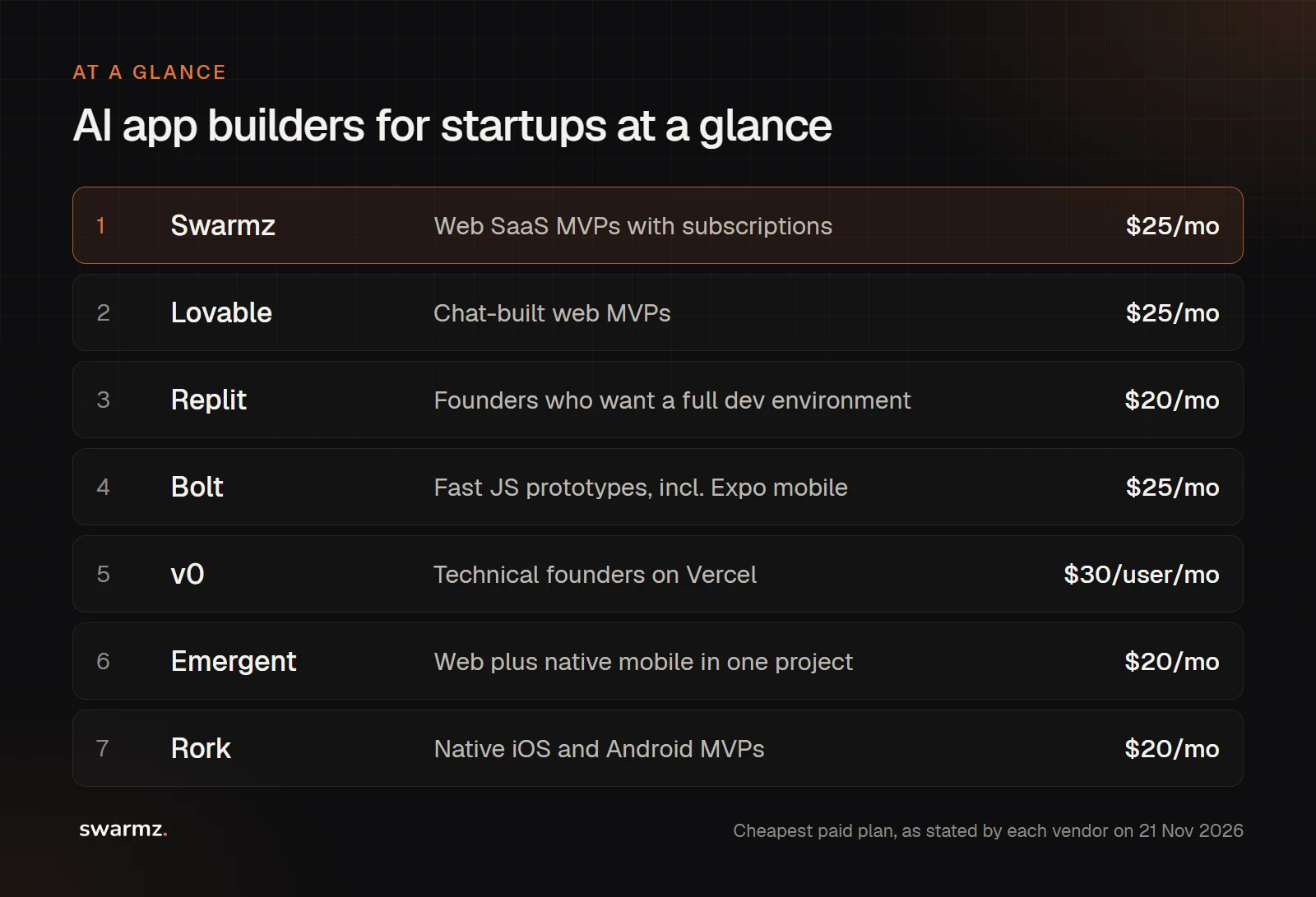
AI app builders for startups at a glance
Tool | Best for | Starting paid price | Backend and sign-in | Payments | Code in GitHub | Native mobile |
|---|---|---|---|---|---|---|
Swarmz | Web SaaS MVPs with subscriptions | $25/month (Pro) | Built in: database, sign-in, storage, functions | Stripe subscriptions, invoices | Two-way, on Free too | No, web apps |
Lovable | Chat-built web MVPs | $25/month, $21 billed yearly | Lovable Cloud or your own Supabase | Stripe with your own account | Git sync to a new repo | No |
Replit | Founders who want a full dev environment | $20/month (Core), $18 billed yearly | Built-in Postgres; Replit Auth or Clerk | Stripe connector on paid plans | GitHub or GitLab | Yes |
Bolt | Fast JavaScript prototypes, incl. Expo | $25/month (Pro) | Bolt Database or Supabase | Stripe announced as private beta | Two-way, with branches | Yes, via Expo |
v0 | Technical founders on Vercel | $30 per user/month (Plus) | Connects to your own backend | Not stated | Two-way, with pull requests | Not stated |
Emergent | Web plus native mobile in one project | $20/month, $17 billed yearly | FastAPI or Next.js with MongoDB | Stripe listed | Push on paid plans | Yes, via Expo |
Rork | Native iOS and Android MVPs | $20/month (Rork Max) | Functions; add Supabase or Firebase | RevenueCat in-app purchases | Two-way on paid plans | Yes, SwiftUI and Kotlin |
What a good startup MVP builder needs
An MVP exists to find out whether people will use and pay for something. The builder you pick should get you there without leaving a mess for the engineers you hire later. We ranked every tool on six points:
A real backend and sign-in. A database with real user accounts, not a clickable mock-up. B2B products often need Google or Microsoft sign-in, and sometimes SSO, early.
Payments and subscriptions. Monthly plans, upgrades, cancellations and invoices, because willingness to pay is what an MVP has to test.
Code you own, in GitHub. A standard stack in your own repository, so your first engineer can review, branch and keep going instead of rebuilding.
Team roles without per-seat pricing. Co-founders, a designer and a contractor in one workspace with the right access, without the bill growing per head.
Cost control. A price you can predict while you change the product every day.
A path to native mobile, if you need it. Some products must be in the App Store on day one; many can start on the web.
No tool wins every line. Swarmz, Lovable and Bolt are strongest on the first four for web products; Rork, Replit and Emergent are the ones to look at for the last. Before you plan a launch, read the limitations of AI app builders.
What it costs while you iterate
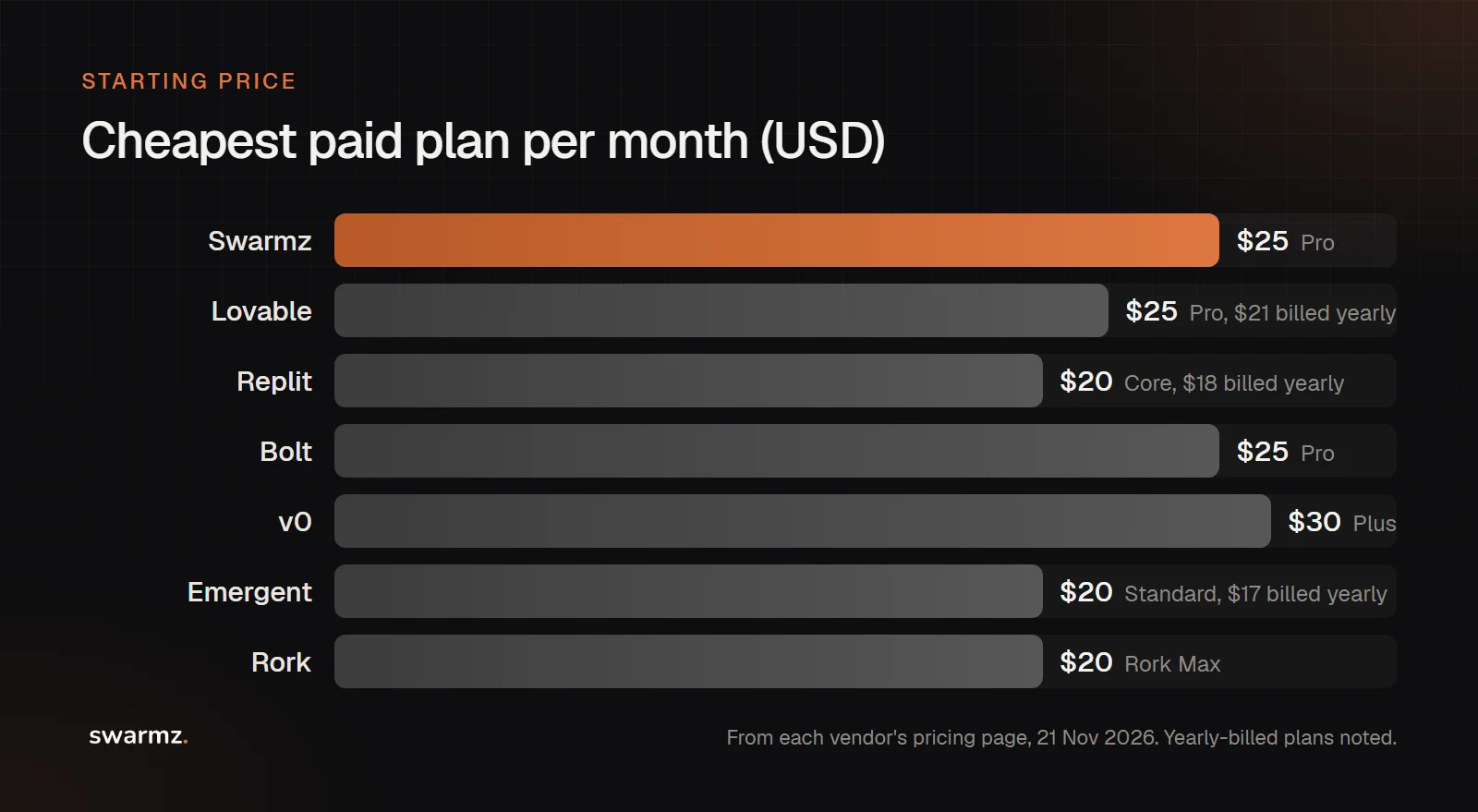
Entry prices are close, $20 to $25 a month for most tools and $30 per user for v0, so the difference is how usage is metered and who counts as a user. Swarmz and Lovable price by credits shared across the workspace, with no per-seat fees. Bolt Teams costs $30 per member and v0 bills per user. Replit's usage-based credits cover AI, publishing, data transfer and database storage, so the bill moves with traffic as well as building. Rork's credit tiers run from $20 for 100 credits to $1,800 for 10,000.
1. Swarmz: best AI app builder for startups overall
Swarmz builds web apps from chat, and the result is a working application rather than a prototype: React, TypeScript and Tailwind code on top of Swarmz Cloud, which provides the database, user sign-in, file storage and server functions on every plan, including Free.
Sign-in covers email, phone, Google, Apple, GitHub, Microsoft, Discord, X and SAML SSO, so a B2B MVP can offer company sign-in from the start. Swarmz Payments runs on Stripe for checkout, subscriptions, invoices and payment links. The code syncs both ways with your GitHub repository on the free plan, so an engineer can work in the repository while you keep building in chat. Teammates get Admin, Editor or Viewer roles and share the workspace's credits. More than 80 connectors, including Supabase, Salesforce, HubSpot and Slack, connect in one click. Your account and main database are hosted in the EU (Ireland), with a selectable Cloud region.
Pros
Database, sign-in, storage, server functions and Stripe subscriptions built in, on every plan.
Standard React and TypeScript code in your own GitHub repository, from the free plan.
The whole team in one workspace with roles and no per-seat fees.
Sign-in options include Microsoft and SAML SSO, which B2B buyers often ask for.
Cons
Web apps only; no native iOS or Android apps.
No ZIP download; the code comes out through GitHub.
Credits are usage-based, so a heavy month of iteration may need a top-up or a larger credit tier.
Best for: founders building a web SaaS, marketplace or B2B tool who want real users and real payments before hiring engineers.
Pricing: Free with 5 credits a day and no card. Pro is $25 a month for 100 credits plus the daily credits, with rollover for 30 days, top-ups, tiers up to 15,000 credits and a custom domain. Business is $50 a month and adds private apps, SAML single sign-on, user groups and custom design systems. New accounts can also try Pro free for 3 days with 25 credits; the trial needs a card and becomes the $25 Pro plan unless you cancel.
2. Lovable: best like-for-like alternative for web MVPs
Lovable builds web apps from chat on Lovable Cloud (database, storage, authentication, realtime and functions) or your own Supabase project, with unlimited workspace members priced by credits rather than seats. Stripe works with your own account on Free; built-in payments need a paid plan. Git sync creates a new repository and cannot connect an existing one, and the database exports separately, without stored files, Edge Function code or secrets. Our Swarmz vs Lovable comparison covers the differences in detail.
Pros: unlimited members; Git sync to GitHub, GitLab or Bitbucket on Free, plus a ZIP on paid plans; a complete built-in backend.
Cons: no native mobile; credit use varies by task, and Cloud and AI usage draw credits too; no custom domain on Free.
Best for: founders comparing chat builders like for like.
Pricing: Pro is $25 a month, or $21 a month billed yearly. Business is $50 a month.
3. Replit: best if you want a full development environment
Replit pairs an AI Agent with a full online development environment, which suits a technical founder who wants to drop into the code. It is also one of the few that builds native iOS and Android apps from the same agent. Built-in PostgreSQL needs no keys, sign-in is Replit Auth or Clerk, and the Stripe connector is available on paid plans, with RevenueCat suggested for mobile subscriptions.
Pros: native mobile; managed Postgres with no setup; real code editing; GitHub or GitLab connect.
Cons: usage-based billing, so costs move with use; the free plan's published app goes down after 30 days; Core allows up to 5 collaborators.
Best for: technical founders who want the AI and a real development environment in one place.
Pricing: Core is $20 a month, or $18 billed yearly, per Replit's pricing page. Pro is $100 a month, or $90 billed yearly.
4. Bolt: best for fast JavaScript prototypes, including Expo mobile
Bolt builds web apps and Expo mobile apps in the browser, with a managed Bolt Database through Bolt Cloud or your own Supabase. The GitHub integration auto-commits, supports branches and picks up outside changes, which helps once an engineer joins. Auth, file storage and Stripe were announced as a private beta.
Pros: an Expo route to mobile; two-way GitHub with branches; a free plan with hosting.
Cons: per-member pricing on Teams; parts of the backend and payments announced as private beta; JavaScript-only backends.
Best for: founders who want a quick JavaScript prototype with a mobile version.
Pricing: Pro is $25 a month billed monthly; Teams is $30 per member a month.
5. v0: best for technical founders on Vercel
v0, now at v0.app, is Vercel's agent for code and full-stack apps. Its strength is the engineering workflow: two-way GitHub sync to a private repository, branches, pull requests and a Vercel preview per branch. It connects to your own APIs and databases; a built-in database, sign-in and payments are not stated on the pages we read.
Pros: a clean pull request flow; one-click Vercel deploys; GitHub sync on the free plan.
Cons: per-user pricing; the $20 Premium plan is being retired, so new users start at $30 per user; you bring your own backend.
Best for: technical founders already on Vercel who want generated code in a normal Git workflow.
Pricing: Plus is $30 per user a month for new users; Business is $100 per user a month.
6. Emergent: best for web plus native mobile from one project
Emergent builds full-stack web apps and React Native apps with Expo, with builds and store submission through EAS. Backends are Python (FastAPI) or Next.js API routes with a MongoDB Atlas database per project, and Stripe is listed. MongoDB only, with no row-level security and no external database clients, is worth raising with whoever you hire.
Pros: native mobile with store submission; a backend provisioned for you; GitHub push and a custom domain on the $20 plan.
Cons: no download button; MongoDB only; free users cannot publish to production.
Best for: founders who need a web app and a mobile app from one project.
Pricing: Standard is $20 a month, or $17 billed yearly. Pro is $200 a month.
7. Rork: best for a native iOS and Android MVP
Rork generates native SwiftUI and Kotlin apps, compiles them in the cloud and submits iOS builds to App Store Connect, with RevenueCat built in for in-app purchases and subscriptions. Rork Backend provides serverless functions; you add Supabase or Firebase for the database. Paid plans get two-way GitHub sync. Android builds are uploaded by hand, and you need an Apple Developer membership.
Pros: real native code; subscriptions through RevenueCat; a direct App Store submission flow.
Cons: the free plan is design-only; the database is something you add; credits get expensive at higher tiers.
Best for: founders whose product has to be a native phone app from day one.
Pricing: Rork Max starts at $20 a month for 100 credits and goes up to $1,800 a month for 10,000.
Build it on Swarmz: a prompt you can copy
A realistic first prompt for a B2B SaaS MVP. Replace the product, the plans and the roles with your own.
Build a SaaS MVP called Rota: shift scheduling for small clinics.
Users sign up with email, Google or Microsoft, create a workspace for their clinic, and invite staff as Admin or Staff.
Admins build a weekly rota; staff see their own shifts on their phone and request swaps, which an admin approves or declines.
Plans: Free for up to 5 staff, and Team at $49 a month with Stripe subscriptions; owners upgrade, downgrade and cancel from a billing page.
Each workspace only ever sees its own data.
Add a founder dashboard, visible only to me, with sign-ups, active workspaces and paying customers.
Keep the code organised by feature with clear names, so a developer can take it over later.
Before you show it to anyone, sign up as two test clinics and check that neither can see the other's rota, then run an upgrade and a cancellation yourself. Connect the GitHub repository early, so the history is there when your first engineer arrives.
When Swarmz isn't the right pick
If your MVP must be a native App Store app, for in-app purchases or native phone features, start with Rork, Replit or Emergent; our guide on whether AI can build a mobile app explains the trade-offs. If you would rather write the code with AI help than describe it, a coding agent such as Cursor or Devin Desktop (formerly Windsurf) fits better; see AI coding agents vs AI app builders. If your team lives in Vercel pull requests, use v0. For a Python backend, Emergent generates FastAPI. For a ZIP of the code, Lovable's paid plans offer one.
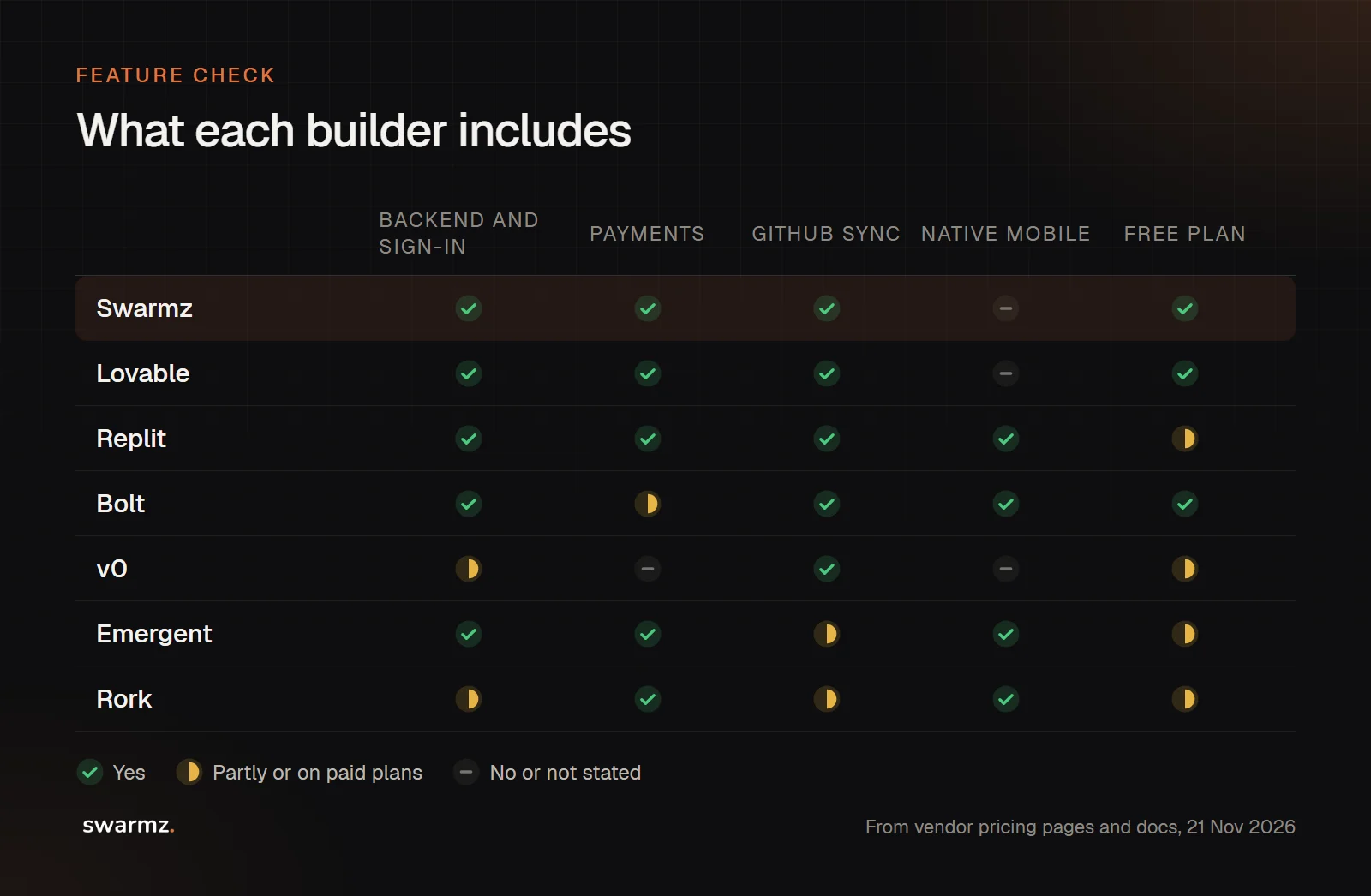
Tool | Backend and sign-in | Payments | GitHub sync | Native mobile | Free plan |
|---|---|---|---|---|---|
Swarmz | Yes | Yes | Yes | No | Yes |
Lovable | Yes | Yes | Yes | No | Yes |
Replit | Yes | Yes | Yes | Yes | Partly |
Bolt | Yes | Partly | Yes | Yes | Yes |
v0 | Partly | No | Yes | No | Partly |
Emergent | Yes | Yes | Partly | Yes | Partly |
Rork | Partly | Yes | Partly | Yes | Partly |
Yes: included. Partly: only on some plans or with limits. No: not offered, or not stated by the vendor. Checked on 21 November 2026.
How to choose
Web SaaS or marketplace MVP with subscriptions and clean code in GitHub: Swarmz.
A chat builder compared like for like: Lovable.
A full development environment, with native mobile as an option: Replit.
A quick JavaScript prototype with an Expo mobile version: Bolt.
Already on Vercel with a pull request workflow: v0.
Web and native mobile from one project: Emergent.
Native iOS and Android first: Rork.
Whatever you pick, decide on day one how you would leave. Our guide on how to export an app from an AI app builder covers what usually comes with you and what can stay behind, such as data, secrets and stored files.
Building it alone, without a technical co-founder? Read the best app builder for non-technical founders.
FAQ
What is the best AI app builder for startups?
For most web startups, Swarmz: it includes a database, sign-in with Google, Microsoft and SAML SSO, Stripe subscriptions and two-way GitHub sync, with team roles and no per-seat fees. For a native mobile MVP, Rork, Replit or Emergent fit better.
Can you build an MVP with an AI app builder?
Yes, if the MVP is a web app with standard parts: sign-up, a database, a handful of core screens and payments. Complex logic, unusual integrations or strict compliance needs still benefit from an engineer reviewing the code before launch.
Can engineers work on code from an AI app builder?
Yes, if the code lands in a normal repository. Swarmz, Lovable, Bolt and v0 sync with GitHub, Replit connects GitHub or GitLab, and Emergent and Rork use GitHub on paid plans.
Can an AI app builder make a native mobile app for my startup?
Some can. Rork generates native SwiftUI and Kotlin apps, Replit builds native iOS and Android apps, and Emergent and Bolt use Expo. Swarmz and Lovable build web apps that work on phones but are not native apps.
How much does it cost to build an MVP with AI?
The tools here start at $20 to $25 a month, or $30 per user for v0, and most have a free plan. What you spend depends on how much you iterate. Our comparison of an AI app builder vs hiring a developer puts those numbers next to the cost of an agency or a first hire.
Start your MVP on the top pick
If your MVP is a web product, start it on Swarmz for free. Paste the prompt above or describe your own idea, and the database, sign-in and GitHub sync are there from the first version.
Sources
All checked on 21 November 2026.
Swarmz: swarmz.net/pricing, swarmz.net/faq, swarmz.net/integrations
Lovable: docs.lovable.dev subscription plans, lovable.dev/pricing, docs.lovable.dev FAQ, Lovable Cloud docs
Replit: replit.com/pricing, Replit Core docs, Replit Starter plan docs, Replit Stripe docs, Replit mobile apps docs
Bolt: bolt.new/pricing, Bolt Cloud announcement, Bolt GitHub integration, Bolt supported technologies
Emergent: emergent.sh/pricing, Emergent FAQ
Bubble: Bubble data ownership
Cursor: cursor.com/pricing
Devin Desktop (formerly Windsurf): Devin Desktop FAQ
How did this land?
About the author

Founder of swarmz.net
Jordan founded Swarmz, the AI app builder at swarmz.net.


